
Key Takeaways
- To account for product loss in can filling, reconcile product entering the agreed process boundary with actual product in released cans, closing stock, recorded returns, samples and discarde…
- This guide is for production, quality and purchasing teams building a batch or shift record. It provides an accounting worksheet and a worked hypothetical example, not a measured Weichi perf…
- Choose one product, batch and time interval. Mark where incoming product is measured and where cans become released output. State whether the supply vessel, connecting pipework, filler bowl,…
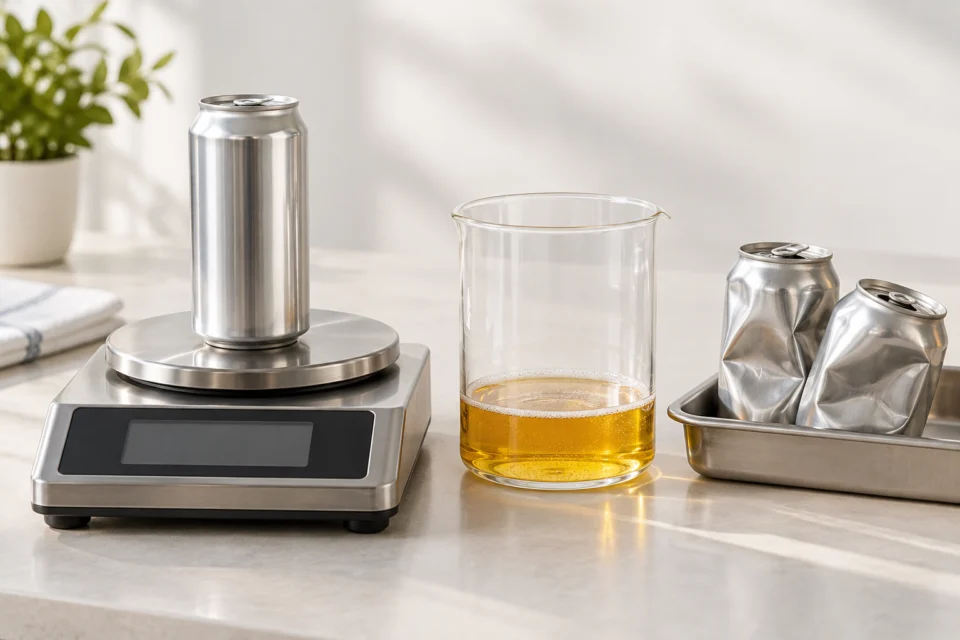
To account for product loss in can filling, reconcile product entering the agreed process boundary with actual product in released cans, closing stock, recorded returns, samples and discarded product. Then examine overfill separately: it is already inside the mass of good output. Adding it again as a physical outflow counts the same material twice.
This guide is for production, quality and purchasing teams building a batch or shift record. It provides an accounting worksheet and a worked hypothetical example, not a measured Weichi performance result or a universal loss target.

1. Fix the boundary before calculating a percentage
Choose one product, batch and time interval. Mark where incoming product is measured and where cans become released output. State whether the supply vessel, connecting pipework, filler bowl, seamer and reject collection are inside that boundary. A tank issue record and a filler inlet meter may describe different boundaries; they cannot be substituted without checking the stock between them.
Record opening and closing product held inside the boundary, including filled cans awaiting release. Product remaining in a bowl at the cutoff is closing stock until its disposition is known. If it is subsequently drained, the next accounting interval must record that discharge against the opening stock. Do not charge the same residue to both shifts.
Use one mass basis, such as kilograms of product excluding cans, lids and collection containers. If a volume measurement must be converted, document the product density and temperature basis. Keep added cleaning water outside the product ledger; diluted wastewater volume is not an equivalent mass of lost product.
2. Separate the destinations that need different decisions
On small screens, swipe the table horizontally to read all columns.
| Record | What belongs here | Double-counting check |
|---|---|---|
| Released good output | Actual net product in released cans, with count and tare method. | Includes any overfill. Do not substitute the label quantity. |
| Closing stock | Product still held inside the boundary, including identified work in progress. | Keep held cans separate from released output. |
| Recorded recovery or return | Product transferred out for a documented, quality-approved destination. | Internal recirculation is not a new external input or output. |
| Discarded product | Product in scrapped filled cans plus separately measured spills, drains and unrecovered residue. | If a rejected can is emptied into a weighed waste container, use one mass record, not both. |
| Samples and other accounted output | Product removed for destructive testing or another recorded destination. | Exclude those cans from released-good count; retain their actual disposition. |
| Unexplained difference | The signed balance remaining after all identified flows and stocks. | Investigate timing, counting and measurement uncertainty before calling it a leak. |
These are operational accounting categories. A formal food-loss-and-waste inventory has its own scope and destination definitions; do not present this worksheet as a certified environmental report. The CEC mass-balance guidance, Appendix A, pages 12–13, explains the use of inputs, outputs, stock changes and processing adjustments, and the effect of uncertain data.

3. Use a balance that leaves the discrepancy visible
Unexplained difference = opening stock + external product input − actual good-output mass − closing stock − recorded returns − discarded product − samples and other accounted output.
This simplified equation assumes no other material additions or transformations. Where evaporation, ingredient addition or another relevant change occurs inside the boundary, add a separately supported adjustment. Never invent an adjustment to force a zero balance. A negative difference also needs investigation; it can indicate an overstated output or a timing or tare error.
For each SKU, estimate good-output mass from released count × representative mean net mass, or use complete net-mass data where available. A sample-derived mean is an estimate: record the sampling coverage, instrument checks, tare basis and uncertainty. Separate startup, normal operation and restart periods when their fill distributions differ.
4. Worked example: 60 kg of overfill is not another drain loss
Hypothetical training example only. Assume a single product, no processing mass adjustment, 30,000 released cans and a correctly established mean net mass of 0.332 kg per can. The reference declared quantity is 0.330 kg. All figures below are invented to demonstrate the calculation.
On small screens, swipe the table horizontally to read all columns.
| Item | Mass (kg) | Basis in this example |
|---|---|---|
| Opening stock | 20 | Product already inside the boundary. |
| External product input | 10,000 | New input during the interval. |
| Actual good output | 9,960 | 30,000 × 0.332 kg. |
| Closing stock | 10 | Identified product held at cutoff. |
| Recorded return | 5 | Leaves the boundary under a separate record. |
| Product in discarded cans | 20 | Net product only, excluding packaging. |
| Separate spills and drains | 15 | Excludes the discarded-can quantity. |
| Destructive samples | 5 | Not included in released output. |
| Unexplained difference | 5 | 10,020 − 9,960 − 10 − 5 − 20 − 15 − 5. |
Good cans contain 30,000 × 0.330 = 9,900 kg at the reference declared quantity. The batch net excess is therefore 9,960 − 9,900 = 60 kg. That 60 kg is already in the 9,960 kg output; subtracting it again would create an artificial discrepancy.
Using new external input as the expressly chosen denominator, recorded discarded product is (20 + 15) ÷ 10,000 = 0.35%, batch net excess is 60 ÷ 10,000 = 0.60%, and unexplained difference is 5 ÷ 10,000 = 0.05%. Report them separately. These percentages are neither benchmarks nor an acceptance specification.
A batch net excess is not the sum of all individual positive deviations when some cans are below the reference. Neither an average nor an accounting balance proves net-content compliance. Keep the individual fill-distribution and release checks in the filling-method and accuracy evaluation; do not reduce the setpoint solely to make an accounting figure smaller.
5. Collect evidence where the loss happens

Use a separate event entry for startup, a stop, restart, product change and end-of-batch drain. Record time, SKU, machine or station, destination, gross mass, container tare, net mass, instrument, reason and record owner. Tag a waste collection container to its interval so that yesterday's residue does not enter today's total.
Where weighing must be estimated, flag the estimate and its method. A counter can establish how many cans were rejected, but empty cans, partially filled cans and full cans need different product-mass assumptions. A photograph helps locate an event; it does not measure its mass.
For water/product changeovers, first determine the actual transition and collection boundary. Tetra Pak's mix-phase reduction description illustrates why phase changes merit separate attention; its equipment solution and benefits must not be attributed to a Weichi configuration without project evidence.
6. Turn the record into a purchasing or improvement test
If excess fill dominates, review the mean and spread by filling station and operating period. If disposal dominates, use the event records to distinguish rejected filled cans, transfer spills and end-of-batch residue. If the unexplained difference dominates, repair the measurement boundary before requesting mechanical changes.
Compare trials using the same product, can, fill target, run length and accounting boundary. Keep quality release, cleaning and safe access requirements intact. The FAT/SAT checklist can carry the agreed measurement method; the changeover planning guide covers first-article release after a format change.
For compatible viscous products, review the Weichi sauce filler-seamer product scope. Send the product conditions, package drawings, batch size, required good output and a loss record through the application enquiry form. Any proposed change, measurement function or loss target must be confirmed for the actual configuration and tested material.
Copyable batch-record fields
Batch / SKU · interval start and end · boundary description · opening stock · new external input · good count and net-mass method · closing stock and held cans · returns and disposition · scrapped-can product · separate spills/drains · samples · supported processing adjustments · signed discrepancy · overfill reference and calculation · denominator · instrument and tare records · estimated entries · investigation owner and review date.
Prepared by Mengdi. Technical review attribution: Hanyong. Content date: September 21, 2026. Sources are linked at the relevant points; numerical examples and the worksheet are explanatory, not customer test records.
Technical Basis and Project Evidence
Final equipment selection and acceptance must use the project product, can and end drawings, utility conditions, line interfaces, agreed test duration, and documented FAT/SAT criteria. Can and end supplier specifications remain authoritative for double-seam limits.
- U.S. FDA: Low-Acid Canned Food Manufacturers, Part 3 — Containers and Closures
- SAMR record: GB/T 30639-2014 — Sauce filling and seaming equipment
- SAMR record: GB/T 40360-2021 — Still-beverage can filling and seaming equipment
Review equipment families See project references Submit application data