
Key Takeaways
- Before a filling and seaming machine is selected, the equipment supplier should receive more than a can diameter and a photograph. A useful submission normally includes controlled drawings f…
- The exact sample quantity should be agreed from the test matrix. It depends on the number of can-and-end combinations, machine heads or stations to be evaluated, operating conditions, repeat…
- Most importantly, a shared nominal diameter does not prove compatibility. The can body, end, tooling, machine handling, product, coating, and process conditions must be reviewed as one packa…
Quick answer
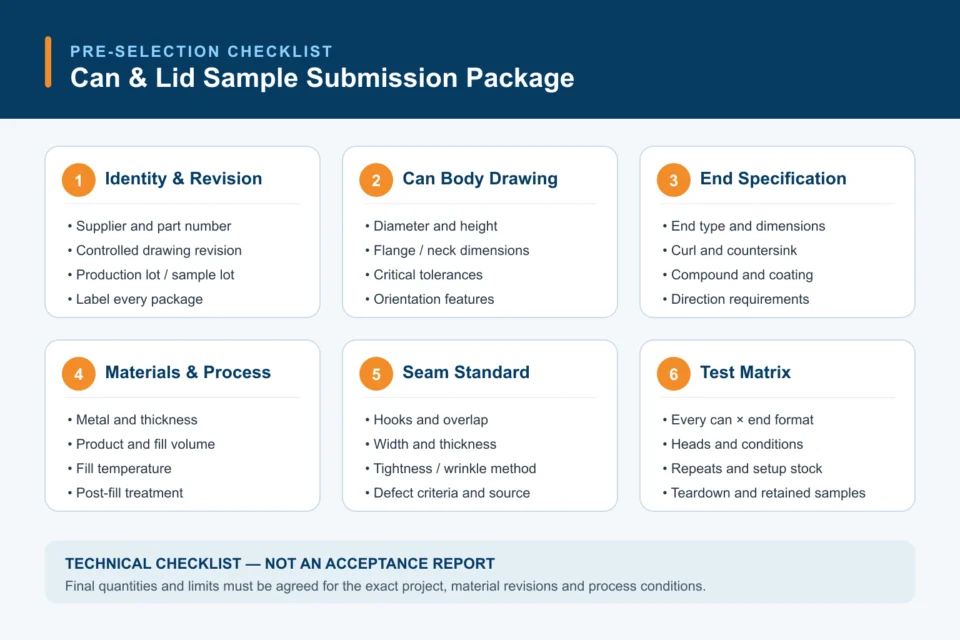
Before a filling and seaming machine is selected, the equipment supplier should receive more than a can diameter and a photograph. A useful submission normally includes controlled drawings for the can body and end, supplier part numbers and drawing revisions, materials and coatings, dimensional tolerances, the approved double-seam specification, representative physical samples, product and process conditions, target output, and the planned acceptance method.
The exact sample quantity should be agreed from the test matrix. It depends on the number of can-and-end combinations, machine heads or stations to be evaluated, operating conditions, repeat runs, destructive seam examinations, and reasonable setup loss. There is no responsible universal quantity for every project.
Most importantly, a shared nominal diameter does not prove compatibility. The can body, end, tooling, machine handling, product, coating, and process conditions must be reviewed as one packaging system. A combination that has not been tested should remain unconfirmed, not described as compatible.
Why samples affect both filling and seaming selection
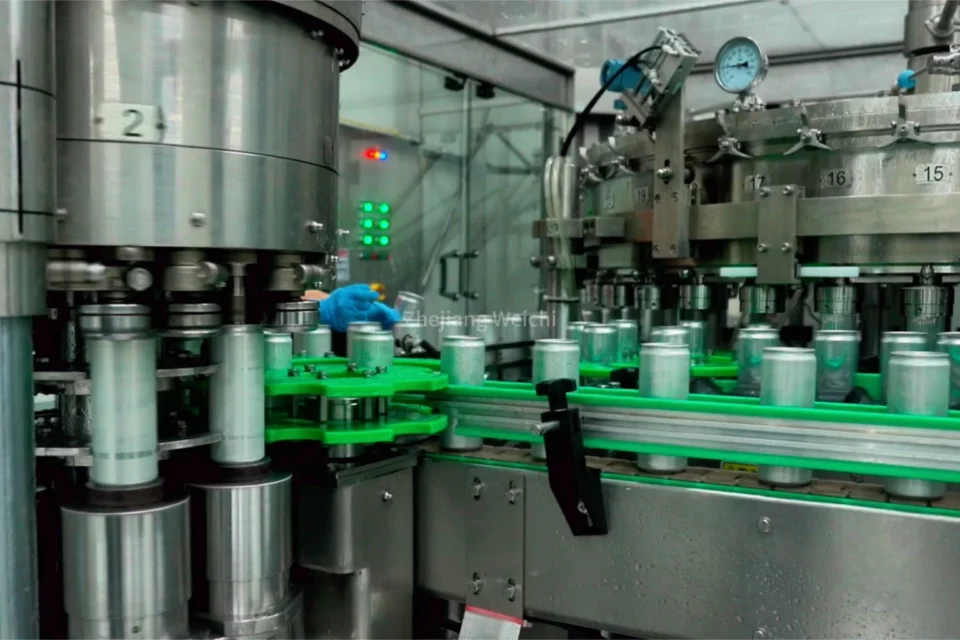
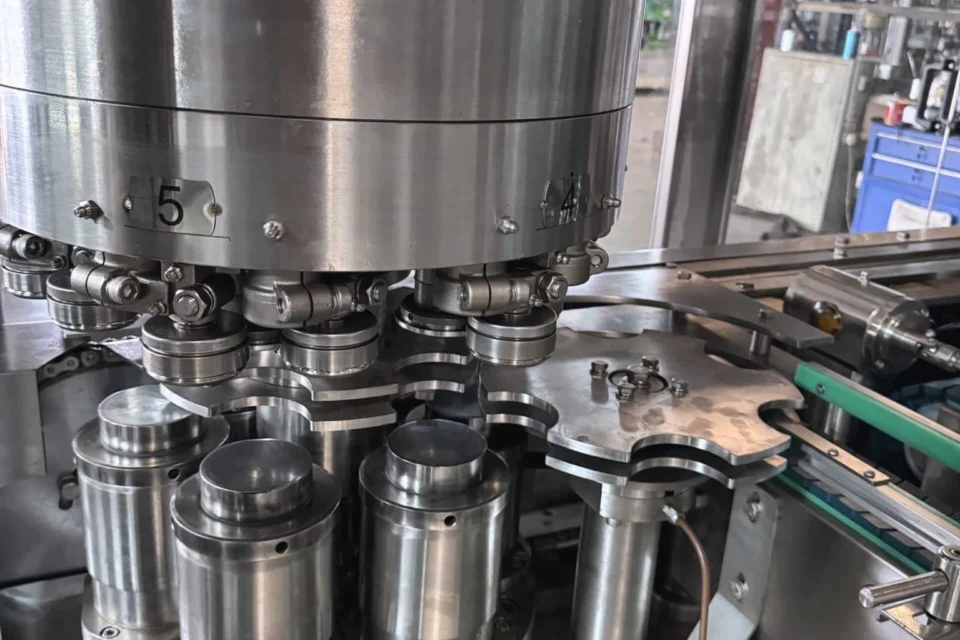
The container passes through more than the closing station. Its diameter, height, neck and bead geometry affect guides, screws, starwheels, lifters, sensors, rinsing or filling supports, lid transfer, seaming tooling, discharge, and downstream conveyors. The end must fit the chuck and roll profiles and form the approved double seam with the actual body flange.
The Canadian Food Inspection Agency explains that double-seam dimensions vary with factors including can shape and size, end and body plate thickness, component manufacture, and seaming equipment. It also states that the can manufacturer provides the seam guideline for each can size and style. That is why a machine builder should not invent a seam target from a generic chart or approve a package from nominal diameter alone.
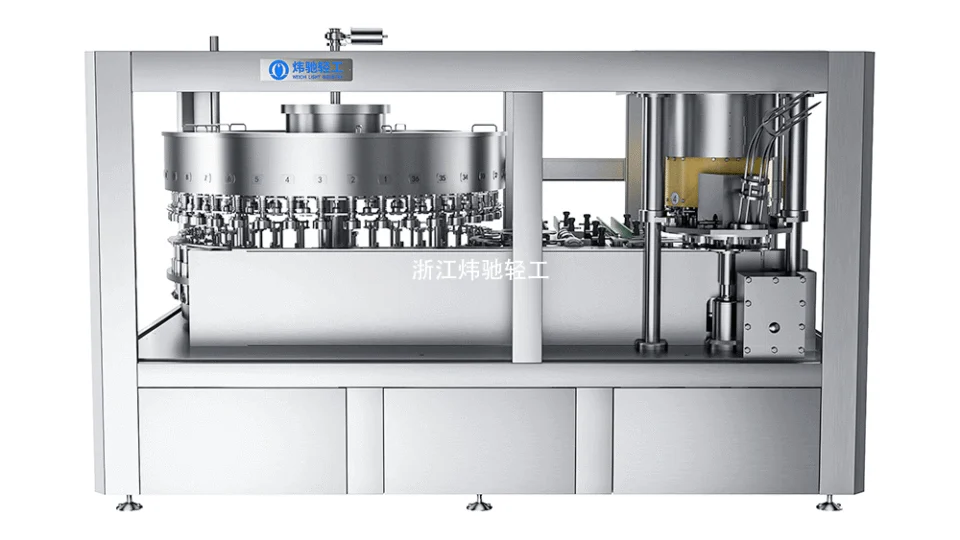
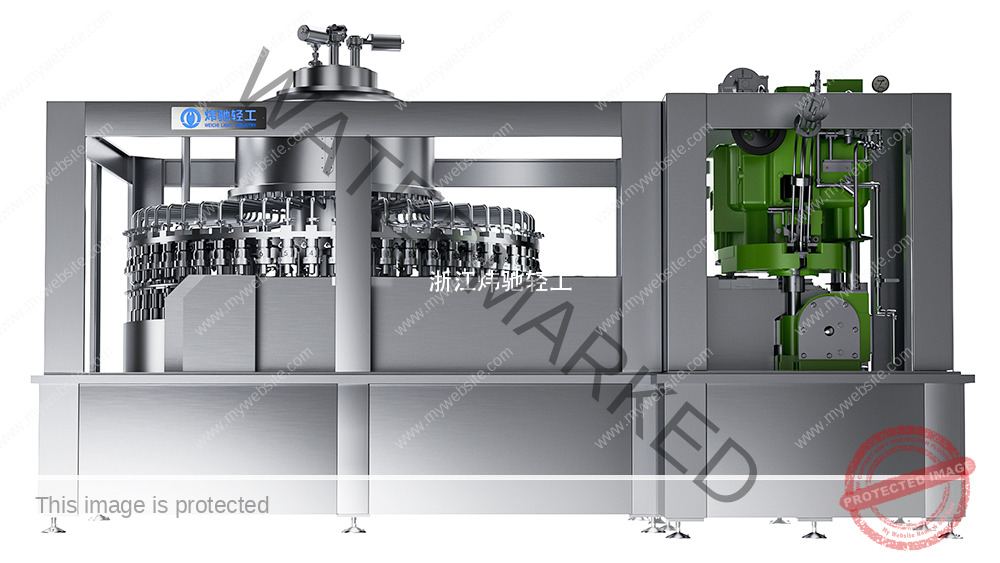
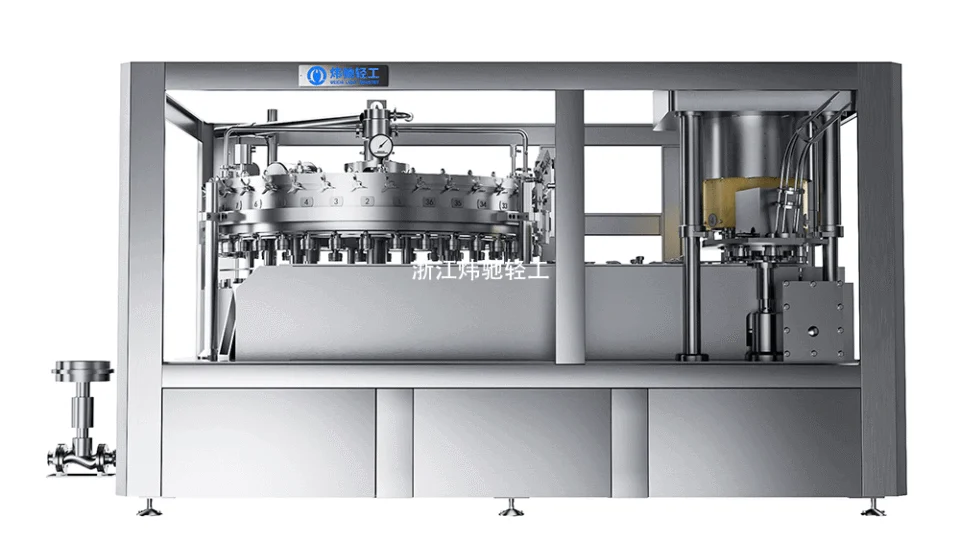
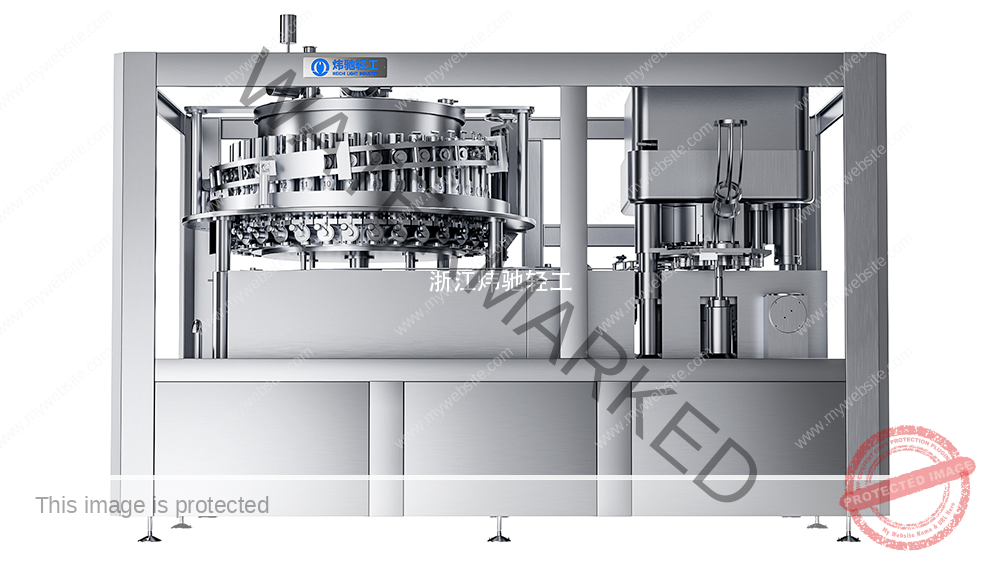
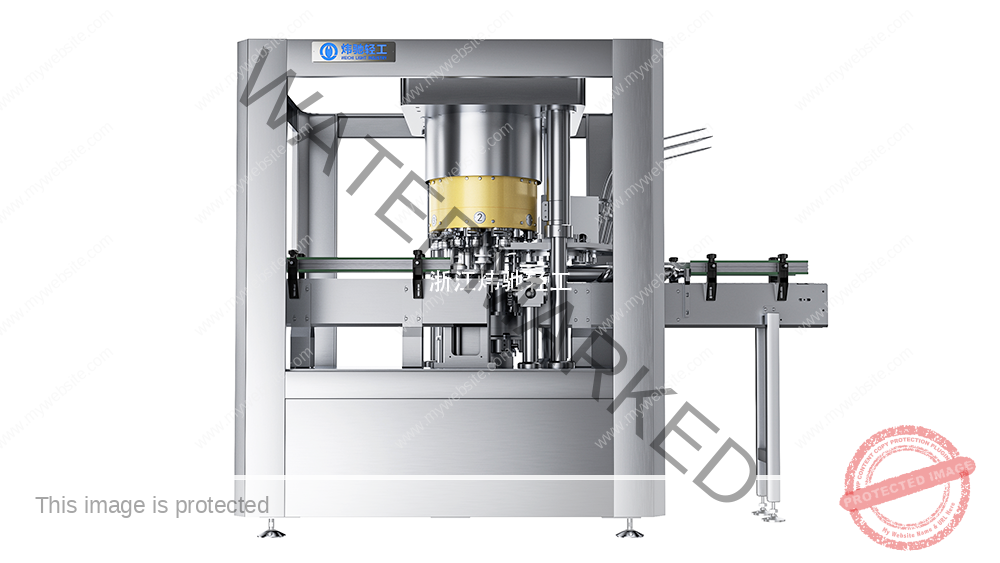
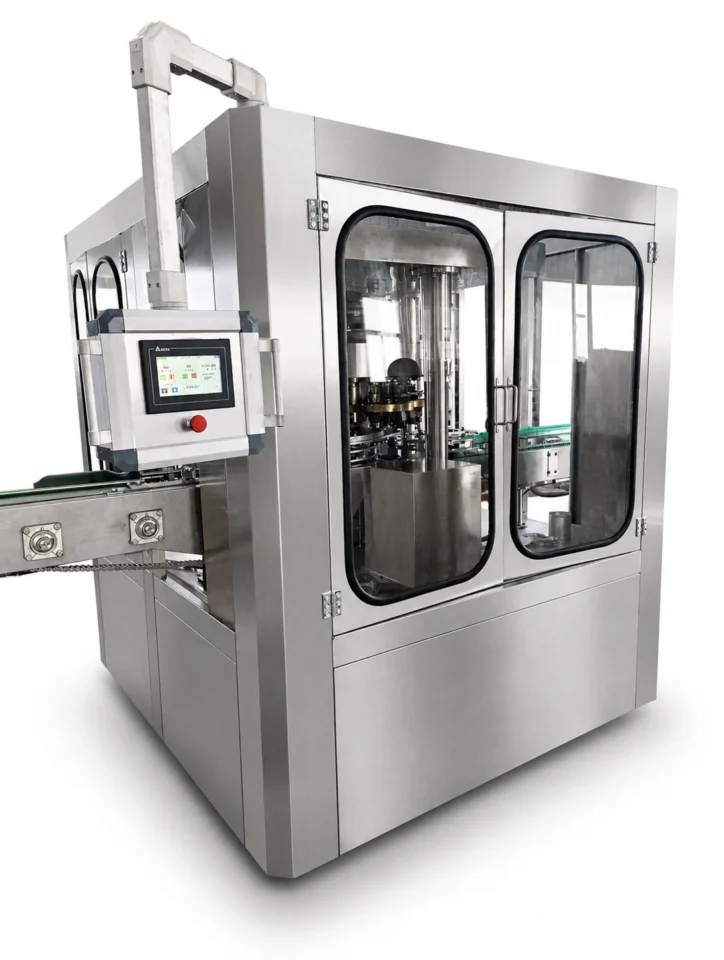
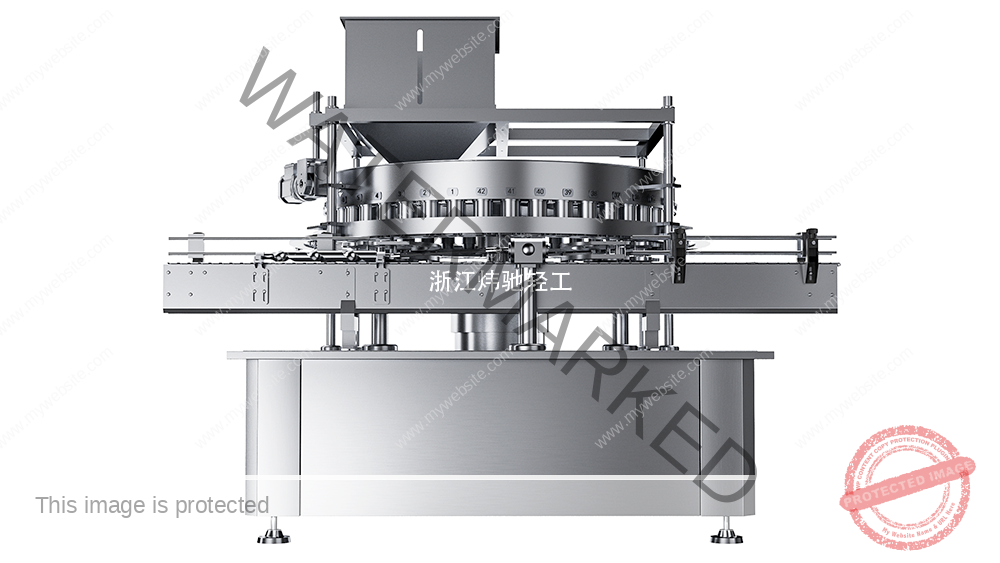
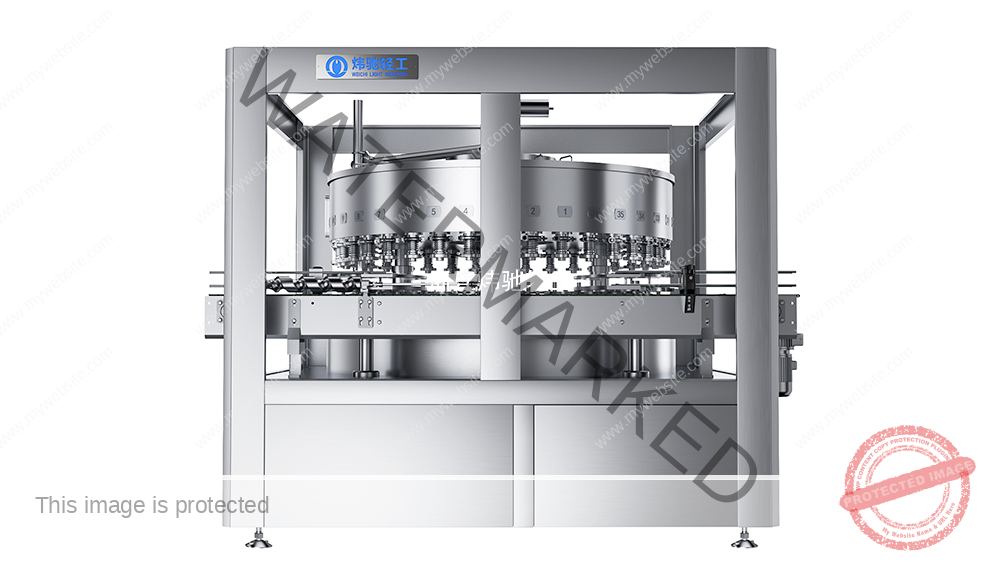
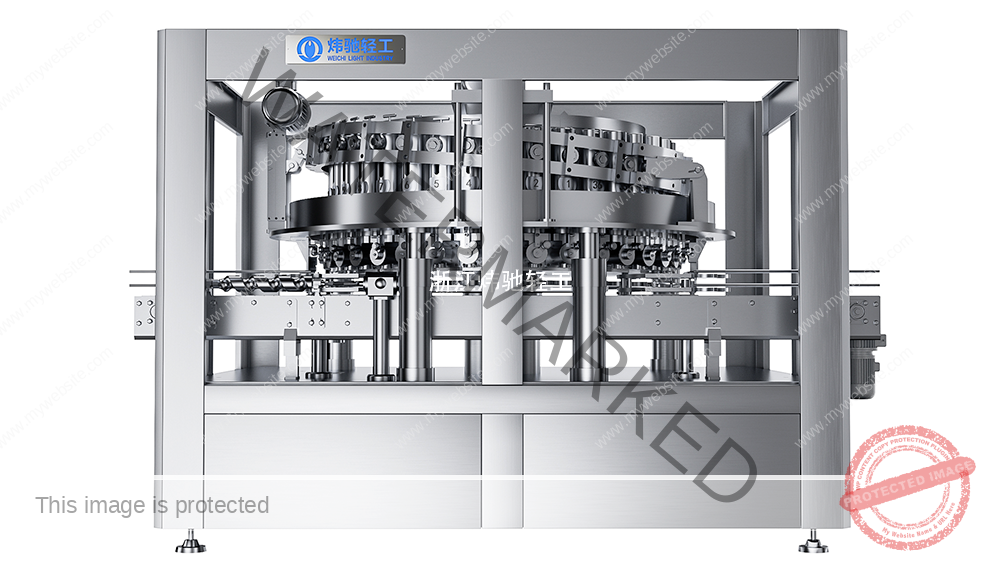
For Zhejiang Weichi equipment, published product ranges are useful for early shortlisting, but the final configuration still requires confirmation of the product, can body, end, fill conditions, line interfaces, output, and acceptance requirements. Samples turn that document review into a controlled fit, handling, filling, and seaming assessment.
1. Identify the exact can body and end
Start with identity, not dimensions. For every can body and end combination, provide:
- Manufacturer and manufacturing location, where relevant.
- Supplier part number, commercial designation, and can/end size code.
- Drawing number, revision, approval date, and units.
- Lot or batch number for the samples.
- Two-piece or three-piece body; round or non-round geometry.
- Plain end, easy-open end, full-aperture end, or another specific end style.
- Whether the samples represent the intended production source or only a preliminary alternative.
If two suppliers use the same nominal size, keep them as separate combinations until their drawings, materials, tolerances, and seam specifications have been compared. Do the same when an easy-open design, shell gauge, compound, coating, or supplier changes.
2. Provide controlled can-body dimensions and tolerances
A body drawing should show the dimensions that control machine handling and double-seam formation, not just nominal capacity. Depending on the container, the review may require:
- Outside diameter at the relevant body, neck, or bead locations.
- Overall height and the permitted height variation.
- Flange width, flange diameter, flange angle or profile, and flange condition requirements.
- Neck, bead, panel, shoulder, bottom, or stacking geometry that contacts handling parts.
- Side-seam and crossover details for a three-piece body.
- Critical runout, roundness, squareness, or concentricity tolerances where specified by the can maker.
- Approved measurement method and reference points.
Do not convert a nominal can code into unverified metric dimensions. Use the supplier's controlled drawing. Where a published machine range appears to include the nominal diameter and height, that proves only an initial size match; it does not prove that the flange, end, tooling, and handling geometry are compatible.
3. Provide the end drawing, material, coating, and compound information
The end submission should identify the geometry and material that interact with the chuck, seaming rolls, lid feed, and can body. Request or provide, as applicable:
- End supplier, part number, type, and drawing revision.
- Shell material and relevant gauge or thickness specification.
- Curl outside diameter and the specified curl profile or dimensions.
- Countersink and seaming-panel geometry.
- Easy-open score, tab, rivet, or full-aperture features that affect handling.
- Sealing compound type, application specification, and any controlled mass or distribution limits supplied by the end maker.
- Internal and external coating system and the declared conditions of use.
- Lot identification and storage requirements.
Material names alone are not enough. For a food or beverage application, the packaging supplier should confirm that the complete food-contact system is suitable for the actual product and process conditions. FDA's food-contact framework distinguishes the substance, the finished material, and the finished article, and authorizations are tied to defined intended uses and conditions. Product acidity, fat or oil, alcohol, salt, fill temperature, thermal treatment, storage time, and temperature can therefore change the compatibility question.
The machine trial can demonstrate mechanical behavior under the agreed test conditions. It does not replace the packaging supplier's food-contact declaration, migration work, corrosion assessment, shelf-life validation, or the user's regulatory responsibility.
4. Supply the approved double-seam specification
The seam specification should come from the can/end supplier or another approved controlled source for the exact combination. Depending on the quality plan, it may include:
- Seam width or length.
- Seam thickness.
- Countersink depth.
- Body-hook and end-hook dimensions.
- Actual or calculated overlap and the required evaluation method.
- Tightness, wrinkle, pressure-ridge, or free-space criteria.
- Visual and local-defect criteria.
- Measurement points, instruments, sample preparation, and frequency.
- Rules for first-operation setup samples, teardown, or cross-section examination.
A single seam-thickness reading cannot prove that the seam is acceptable. Hook formation, overlap, tightness, local defects, material condition, and repeatability may also be required by the approved plan.
5. Send representative, matched, undamaged samples
Physical samples should match the documents. A useful shipment normally contains empty bodies and matching ends from identified lots, plus any production-intent product or test medium agreed for filling trials.
Before shipping:
- Protect body flanges and end curls from dents, flattening, contamination, and abrasion.
- Pack different suppliers, sizes, revisions, coatings, and lots separately.
- Label each group with a sample ID that also appears on the drawing and packing list.
- Mark which bodies and ends are approved production candidates and which are alternatives.
- Include enough reserve to replace transit-damaged parts without changing the trial lot.
- Confirm whether tested or destructively examined samples must be retained or returned.
Do not send only previously seamed finished cans. Finished cans can help communicate the intended pack and provide reference measurements, but unseamed bodies and loose ends are still needed for tooling, feed, setup, and controlled seam trials.
How many cans and ends should be sent?
Use a test matrix instead of a fixed number. A practical planning calculation is:
Required units = setup and handling units + low-speed trial units + units for every planned operating condition + destructive inspection units + repeatability units + an agreed reserve
The matrix should explicitly account for:
- Every can-body and end combination.
- Every supplier or drawing revision that must be approved.
- Empty, water, test product, and production-intent product conditions, where applicable.
- Relevant fill temperature, carbonation or pressure, headspace, and vacuum conditions.
- Each seaming head or station that must be sampled.
- Start-up, steady-state, speed-change, stop/restart, and changeover checks in the agreed scope.
- Destructive teardown or cross-section samples that cannot be reused.
- Repeats needed to show stability rather than a single good result.
The equipment supplier should propose the quantity after the documents and acceptance plan are reviewed. If the sample quantity cannot cover the agreed matrix, reduce the claimed test scope rather than extrapolating an untested conclusion.
6. Describe the product and process conditions
The same package may behave differently under different filling and processing conditions. Provide:
- Product type and formulation category.
- Presence of carbonation, pulp, particles, oil or fat, alcohol, salt, or other relevant characteristics.
- Product viscosity and particle-size range where they affect filling.
- Target fill volume or weight and allowed tolerance.
- Fill temperature, product temperature range, and foam behavior.
- Headspace, vacuum, gas flushing, steam flow, or pressure objective where applicable.
- Hot-fill, pasteurization, retort, cooling, refrigeration, freezing, or ambient-storage conditions.
- Required container rinsing, sanitation, and cleaning conditions.
- Target output and the upstream/downstream line interfaces.
This information separates three decisions that are often confused: whether the container can be handled, whether the product can be filled under the intended conditions, and whether the resulting closure meets the approved seam and package-integrity criteria.
7. Agree on the compatibility and acceptance test before the trial
Define what the trial will and will not prove. A project-specific protocol may cover:
| Review area | Typical evidence | Boundary |
|---|---|---|
| Document match | Drawing revisions, sample IDs, supplier parts, lots | Does not prove physical performance |
| Machine handling | Feed, guides, starwheels, transfers, lid placement, discharge | Limited to the tested format and speed range |
| Filling | Fill result, spillage/foam, container stability, agreed product conditions | Limited to the tested product and temperature |
| Seaming | Tooling match, full-circumference appearance, approved measurements and destructive checks | Acceptance limits come from the approved seam specification |
| Package/process compatibility | Coating declaration, corrosion/migration and thermal-process evidence | Usually owned jointly by packaging supplier and packer, not proved by a short machine trial |
| Repeatability | Results by head/station, run condition, and repeat | Does not extend to untested suppliers, revisions, or lots |
Record the machine, tooling, can and end identities, product condition, settings, output, sample positions, measurements, defects, and disposition. If a condition changes, classify the change and decide whether document review, partial retest, or full revalidation is required.
What the pre-selection review should conclude
A clear review should place each proposed combination into one of four states:
- Document review complete; physical trial still required.
- Trial completed within the recorded conditions; acceptance review pending.
- Additional tooling, change parts, samples, or data required.
- Not confirmed for the proposed machine or process.
Avoid the vague word "compatible" unless the exact scope is stated: which body, which end, which drawing revisions, which product, which conditions, which tooling, which output range, and which acceptance plan.
A practical submission checklist
Before requesting a final machine recommendation or quotation, send:
- Can-body and end drawings with revisions and tolerances.
- Supplier part numbers, materials, coatings, compound information, and lot IDs.
- Approved double-seam specification and inspection method.
- Representative matched bodies and loose ends, protected and labelled.
- Product and process specification.
- Target output and line-interface information.
- Proposed FAT or sample-trial matrix and acceptance responsibilities.
- A list of alternative formats or future changeovers that must be considered separately.
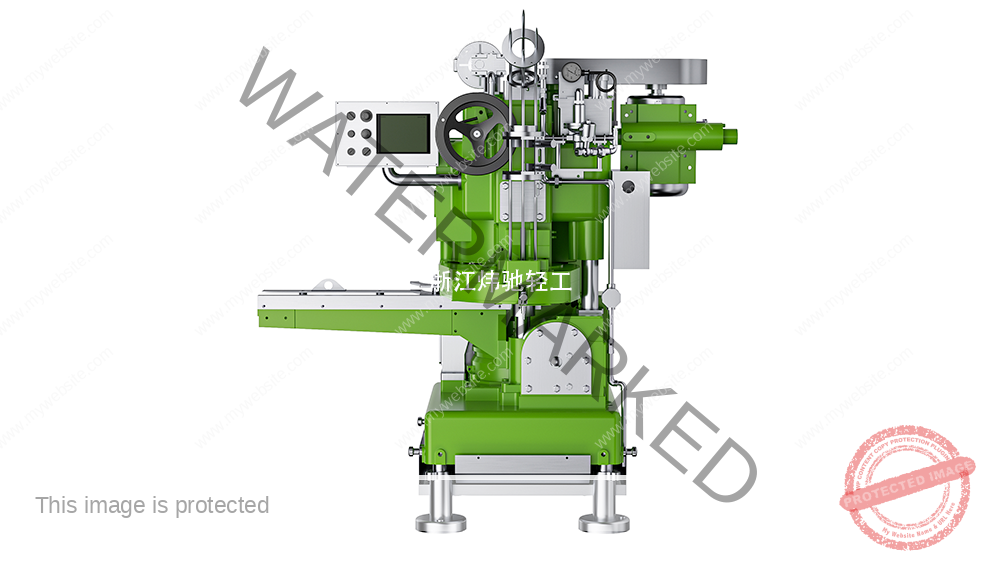
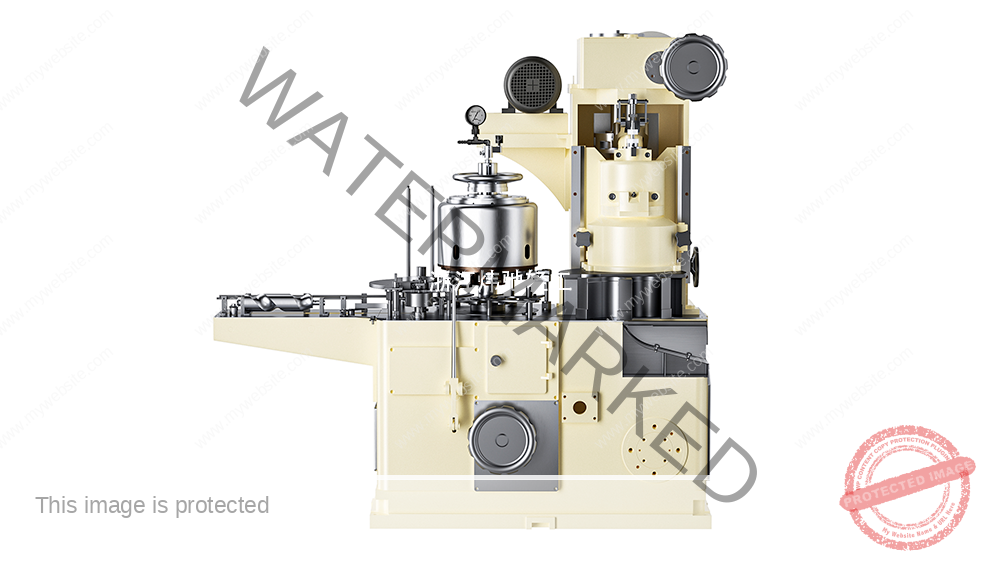
Zhejiang Weichi can review this package against the relevant filling and seaming equipment family and propose the next engineering step. See the automatic can seaming machine page for an initial equipment overview, and use the double-seam adjustment guide for the controlled logic applied after the correct package and tooling have been identified.
Frequently asked questions
Are photos and nominal can dimensions enough for a quotation?
They may support a preliminary conversation, but not a final compatibility conclusion. Controlled drawings, revisions, tolerances, material information, seam requirements, and representative samples are needed to define the engineering scope.
Can one end be used with any can body of the same nominal diameter?
No assumption should be made from nominal diameter alone. Flange and curl geometry, material thickness, compound, tooling profiles, and the approved seam specification must match the exact combination.
Can existing finished cans replace empty bodies and loose ends?
No. Finished cans are useful references, but machine setup and controlled trials require unseamed bodies and matching loose ends.
Is there a standard number of samples for every seamer trial?
No. The number should be calculated from the approved test matrix, including formats, heads or stations, conditions, repeats, destructive checks, setup loss, and reserve.
Does a successful short trial prove shelf-life or coating compatibility?
No. It can provide evidence about mechanical handling, filling, and seaming under recorded conditions. Food-contact compliance, coating suitability, corrosion resistance, thermal-process performance, and shelf life require the appropriate supplier declarations and validation program.
When should a can or end change trigger revalidation?
Review any change in supplier, part number, drawing revision, material or gauge, coating, compound, easy-open design, flange or curl geometry, product, process condition, tooling, or speed. The change assessment should determine whether document review, partial retest, or full revalidation is needed.
Conclusion
Selecting a can filler and seamer begins with a controlled packaging definition. Drawings establish identity and tolerances; physical samples reveal handling and tooling behavior; the seam specification defines the closure target; and the test matrix defines what the trial can prove.
The safest procurement decision is not "this nominal size should work." It is a documented statement that a specific can body, end, product, process, tooling set, and acceptance plan have been reviewed and, where required, tested together. Untested combinations remain unconfirmed until that evidence exists.
Technical references
- Canadian Food Inspection Agency — Metal can defects: identification and classification
- Can Manufacturers Institute — Voluntary Can and End Dimension Reference Manual
- U.S. FDA — Food Packaging and Other Substances that Come into Contact with Food
- U.S. FDA — Food Types and Conditions of Use for Food Contact Substances
Technical Basis and Project Evidence
Final equipment selection and acceptance must use the project product, can and end drawings, utility conditions, line interfaces, agreed test duration, and documented FAT/SAT criteria. Can and end supplier specifications remain authoritative for double-seam limits.
- U.S. FDA: Low-Acid Canned Food Manufacturers, Part 3 — Containers and Closures
- SAMR record: GB/T 30639-2014 — Sauce filling and seaming equipment
- SAMR record: GB/T 40360-2021 — Still-beverage can filling and seaming equipment
Review equipment families See project references Submit application data